
 Husain Parvez
The Short Answer
The best proxy for web scraping overall is Oxylabs — a 175M+ pool plus a Web Scraper API and a 99.8%+ success rate. Bright Data is best for the hardest anti-bot targets with its Web Unlocker, Decodo is the best value for beginners, Webshare is cheapest for high-volume datacenter crawls, Thordata is the budget pick with bundled scraping tools, and Swiftproxy is the cheapest residential.
About our Methodology and Testing
We judged each provider on what matters for scraping: success rate on real, defended targets, pool size and IP cleanliness, the proxy types on offer, whether a Web Scraper API or Web Unlocker is available for anti-bot sites, targeting and session control, and cost per GB. We ran high-volume crawls across easy and hard targets.
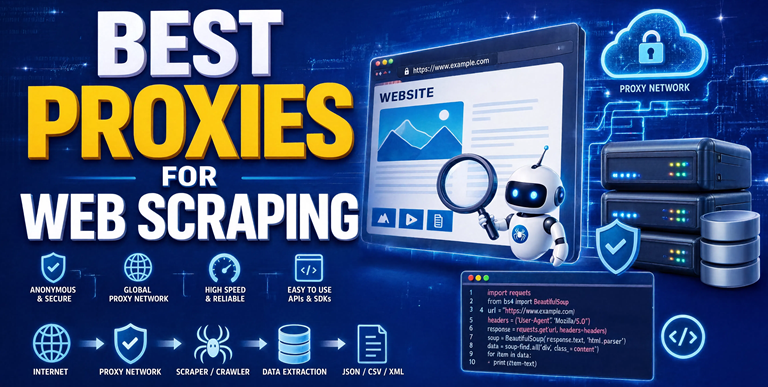
Web scraping falls apart without proxies: send thousands of requests from one IP and you hit rate limits, CAPTCHAs, and blocks, and the data comes back full of holes. Proxies spread requests across many IPs so a target sees ordinary, distributed traffic, letting you extract prices, listings, reviews, and search data at scale and from the exact locations you need.
The best scraping proxies separate themselves on success rate, pool cleanliness, and the tools they add on top — Web Scraper APIs and Web Unlockers that beat anti-bot defenses automatically. Here are the providers worth your budget, with honest pros and cons for each. Read more…
Best Proxy for Web Scraping: Editor’s Choice
Best Proxies for Web Scraping: Top Picks!
|
|
|
|
|
|
| Provider | Oxylabs | Bright Data | Decodo | Webshare |
| Scraper tools | Web Scraper API | Web Unlocker | Site Unblocker | Raw proxies |
| Residential IPs | 175M+ | 150M+ | 115M+ | 80M+ |
| Success rate | 99.8%+ | Very high | High | Good (DC) |
| Free option | Free trial | Trial + credits | 3-day trial | 10 proxies + 1 GB/mo |
| 24/7 support | ✅ | ✅ | ✅ | ✅ |
| Link | Try Now | Try Now | Try Now | Try Now |
1) Oxylabs

Best Overall for Web Scraping
Oxylabs is the most reliable web scraping network, pairing a 175M+ residential pool (plus datacenter and mobile) with a Web Scraper API that returns parsed data past anti-bot defenses — and the highest success rates we measured.
For raw scraping you get huge, clean rotating pools with country, city, ZIP, and ASN targeting and both rotating and sticky sessions; for hands-off scraping, the Web Scraper API handles rendering, retries, and parsing for you.
A 99.8%+ success rate and ~1-second responses keep large jobs completing on schedule, even on defended targets.
24/7 support, account managers, and a free trial make it the safe pick for teams that cannot afford failed crawls.
Why Oxylabs?
Oxylabs’ 175M+ pool, Web Scraper API, and 99.8%+ success rate make it the most dependable proxy for web scraping at scale.
What We Like
- ✓Huge 175M+ residential pool + datacenter + mobile
- ✓Web Scraper API handles rendering and parsing
- ✓City/ZIP/ASN targeting, rotating and sticky
- ✓24/7 support + free trial
What We Don’t Like
- ✗Premium pricing at entry tiers
- ✗Feature depth suits teams
- ✗Learning curve for beginners
Pricing Plans
| Best For | Reliable scraping at scale |
| Scraper Tools | Web Scraper API + proxy manager |
| Residential IPs | 175M+ (plus DC + mobile) |
| Success Rate | 99.8%+ |
| Free Option | Free trial |
| Support | 24/7 + Account Manager |
Free Trial Available
2) Bright Data

Best for the Hardest Anti-Bot Targets
Bright Data operates the largest scraping infrastructure and the strongest unblocking tools: a 150M+ residential network plus Web Unlocker and a Scraping Browser that automatically clear CAPTCHAs and anti-bot walls on the toughest sites.
When a target defeats ordinary proxies, Bright Data’s Web Unlocker retries, rotates, and solves challenges until it gets the page — billed on success.
Flexible per-GB or per-IP billing across residential, datacenter, ISP, and mobile, plus a compliance-first, KYC-verified approach for regulated industries.
A free trial with credits and no card at signup lets you test the platform first.
Why Bright Data?
Bright Data’s Web Unlocker, Scraping Browser, and 150M+ network make it the most capable proxy for scraping the hardest anti-bot targets.
What We Like
- ✓Web Unlocker + Scraping Browser beat tough anti-bot walls
- ✓Largest combined network across all types
- ✓Flexible per-GB or per-IP billing
- ✓Free trial with credits, no card
What We Don’t Like
- ✗Steeper learning curve
- ✗KYC onboarding
- ✗Premium positioning
Pricing Plans
| Best For | Hardest anti-bot targets |
| Scraper Tools | Web Unlocker + Scraping Browser |
| Residential IPs | 150M+ (all types) |
| Billing | Per-GB or per-IP |
| Free Option | Free trial with credits |
| Support | 24/7 + Account Manager |
Free Trial Available
3) Decodo

Best Value for Beginners
Decodo (formerly Smartproxy) is the easiest scraping proxy to start with, combining a 115M+ residential pool and a Site Unblocker with a beginner-friendly dashboard and pricing that scales to $2/GB.
A 3-day free trial, free browser extension, and fast onboarding get first-time scrapers running in minutes, with city, state, ZIP, and ASN targeting and rotating or sticky sessions.
The Site Unblocker handles JavaScript rendering and basic anti-bot challenges for defended pages, and datacenter, residential, and mobile cover every scraping budget.
24/7 live chat and a deep knowledge base make it the most approachable network for learning to scrape.
Why Decodo?
Decodo’s 115M+ pool, Site Unblocker, and $2/GB pricing make it the best-value, most beginner-friendly proxy for web scraping.
What We Like
- ✓3-day free trial + beginner-friendly dashboard
- ✓Scales to $2/GB as volume grows
- ✓Site Unblocker handles rendering and anti-bot
- ✓City/ZIP/ASN targeting, rotating and sticky
What We Don’t Like
- ✗Free trial needs card verification
- ✗Smaller pool than Oxylabs/Bright Data
- ✗Pay-as-you-go rate is steep
Pricing Plans
| Best For | Beginners & value scraping |
| Scraper Tools | Site Unblocker |
| Residential IPs | 115M+ (plus DC + mobile) |
| Targeting | Country, city, state, ZIP, ASN |
| Free Option | 3-day free trial |
| Support | 24/7 Live Chat |
3-Day Free Trial
4) Webshare

Best Cheap Datacenter Scraping
Webshare is the cheapest way to scrape at volume: free datacenter proxies (10 proxies plus 1 GB a month) to start, and paid datacenter plans from $2.99 for 100 IPs — fast, disposable IPs ideal for high-throughput crawls of lighter targets.
Datacenter proxies are the fastest and cheapest for bulk scraping where you do not need to look like a home user, and Webshare’s are the lowest cost here.
Self-serve setup, an API, and downloadable lists plug straight into any scraper or framework; HTTP and SOCKS5 are both supported.
For defended pages, the 80M+ residential pool is available from around $1.19/GB.
Why Webshare?
Webshare’s free tier and $2.99 datacenter plans make it the cheapest proxy for high-volume web scraping of lighter targets.
What We Like
- ✓Free tier to test your scraper
- ✓Cheapest datacenter proxies for bulk crawls
- ✓API and proxy lists integrate with any framework
- ✓80M+ residential when accuracy matters
What We Don’t Like
- ✗No scraper API or unblocker
- ✗Datacenter IPs flag on defended sites
- ✗Country/city targeting only
Pricing Plans
| Best For | Cheap, high-volume datacenter scraping |
| Scraper Tools | None — raw proxies + your scraper |
| Residential IPs | 80M+ (plus datacenter) |
| Pricing | Free / from $2.99 datacenter |
| Free Option | 10 proxies + 1 GB/month |
| Support | 24/7 Support & Docs |
Free Forever Plan
5) Thordata

Best Budget Scraping with Built-In Tools
Thordata is the best budget scraping network, bundling a Web Scraper, SERP API, and Web Unlocker with 60M+ residential IPs from about $1.05/GB — plus a 1 GB free trial to test scraping at no cost.
The included Web Unlocker handles JavaScript and anti-bot systems, so you get clean data without building that layer — rare at this price point.
Pay-as-you-go with no monthly minimum keeps costs low for irregular scraping workloads, and datacenter and ISP options round out the network.
Not the fastest, but the success rates hold up well on everyday targets for the money.
Why Thordata?
Thordata’s 1 GB free trial, ~$1.05/GB pricing, and bundled Web Scraper/Unlocker make it the best budget proxy for scraping with tooling included.
What We Like
- ✓Bundled Web Scraper, SERP API, and Web Unlocker
- ✓Very cheap — from ~$1.05/GB
- ✓1 GB residential free trial
- ✓Pay-as-you-go, no minimum
What We Don’t Like
- ✗Trial unlocked via support only
- ✗Smaller pool (60M+)
- ✗Not the fastest under heavy load
Pricing Plans
| Best For | Budget scraping with tools |
| Scraper Tools | Web Scraper + Web Unlocker |
| Residential IPs | 60M+ (plus DC + ISP) |
| Pricing | From ~$1.05/GB |
| Free Option | 1 GB free trial |
| Support | 24/7 Support |
1 GB Free Trial
6) Swiftproxy

Cheapest Residential for Scraping
Swiftproxy makes residential scraping affordable at around $0.70/GB with traffic that never expires, plus real-time IP checks that auto-remove flagged addresses to keep success rates high on a budget.
For scraping defended sites without paying premium rates, Swiftproxy’s 80M+ pool and non-expiring traffic are hard to beat, especially for occasional or seasonal jobs.
ISP proxies from $6/IP add a stable identity for account-linked scraping, and 99.89% uptime keeps long crawls steady.
It is a leaner platform than the enterprise names, but the value is excellent for straightforward scraping.
Why Swiftproxy?
Swiftproxy’s ~$0.70/GB residential, non-expiring traffic, and auto-cleaned IPs make it the cheapest reliable residential proxy for web scraping.
What We Like
- ✓Cheapest residential for scraping (~$0.70/GB)
- ✓Traffic never expires — great for occasional jobs
- ✓Auto-removes flagged IPs
- ✓ISP proxies for account-linked scraping
What We Don’t Like
- ✗No scraper API or unblocker
- ✗Residential/ISP focus, smaller brand
- ✗Free trial availability varies
Pricing Plans
| Best For | Cheap residential scraping |
| Scraper Tools | None — raw proxies + your scraper |
| Residential IPs | 80M+ (plus ISP) |
| Pricing | From ~$0.70/GB |
| Free Option | Varies — confirm |
| Support | 24/7 Support |
Check Current Offer
What Is Web Scraping and Why Do You Need Proxies?
Web scraping is the automated extraction of data from websites — prices, product details, reviews, listings, search results, and more. At any real volume, sending thousands of requests from one IP gets you rate-limited, served CAPTCHAs, or blocked outright, and the data comes back incomplete.
Proxies solve this by spreading requests across many IP addresses so the target sees ordinary, distributed traffic instead of one aggressive client. The right proxies let you scrape at scale, reliably, and from the locations your data needs.
Which Proxy Type Is Best for Web Scraping?
It depends on the target:
- Datacenter: Fastest and cheapest — ideal for high-volume scraping of sites without strong anti-bot defenses.
- Residential: Real home IPs that rarely get blocked — the default for defended sites, marketplaces, and localized data.
- ISP: Residential trust at datacenter speed with a stable IP — good for account-linked scraping.
- Mobile: Hardest to block, for the most aggressive targets, but the priciest.
Rotating vs Sticky Proxies for Scraping
Rotating proxies assign a new IP on each request or interval, spreading a large crawl across many addresses so you never trip rate limits — the default for high-volume scraping. Sticky proxies hold the same IP for minutes to hours, which you need when a scrape must stay logged in or complete a multi-step flow. Most scraping uses rotation, with sticky reserved for session-based tasks.
Web Scraper APIs and Web Unlockers
Beyond raw proxies, the top providers offer tools that do the hard part for you. A Web Scraper API (Oxylabs, Thordata) sends a URL and returns parsed data, handling rotation, rendering, and retries. A Web Unlocker or Scraping Browser (Bright Data, Thordata, Decodo’s Site Unblocker) automatically solves CAPTCHAs and anti-bot challenges, billed on success. These save enormous engineering time on defended targets.
How to Avoid Getting Blocked While Scraping
Reduce blocks by rotating a large pool and using residential or ISP IPs on defended sites, throttling and randomizing request timing so traffic looks human, sending realistic headers and managing cookies and sessions properly, and respecting each site’s rate limits. When a site keeps blocking you, a Web Unlocker that solves challenges automatically is the most reliable fix.
Handling CAPTCHAs and Anti-Bot Systems
Modern sites use CAPTCHAs, fingerprinting, and anti-bot services to stop scrapers. Clean residential or mobile IPs get you past the first line of defense, but for the toughest targets you want an unblocking layer: Bright Data’s Web Unlocker and Scraping Browser, Thordata’s Web Unlocker, or Decodo’s Site Unblocker retry, rotate, and solve challenges automatically so your scraper receives a clean page.
What to Look for in a Web Scraping Proxy
Prioritize these:
- Success rate: The real measure of a scraping proxy on live targets.
- Pool size and cleanliness: Large, unflagged pools mean fewer blocks.
- Proxy types: Datacenter for speed, residential for stealth, plus mobile/ISP when needed.
- Scraper tools: A Web Scraper API or Web Unlocker for defended sites.
- Targeting and sessions: Geo-targeting plus rotating and sticky options.
- Value and a trial: Fair per-GB pricing and a way to test first.
How to Set Up Proxies for Web Scraping
Step 1) Pick a provider — datacenter like Webshare for cheap bulk crawls, residential like Oxylabs or Swiftproxy for defended sites, or a Web Scraper API for hands-off scraping. Step 2) Choose rotating or sticky sessions and your target locations. Step 3) Copy the gateway endpoint and credentials, or download the proxy list, and add them to your scraper or framework. Step 4) Set a sensible request rate and retries, run a test batch to confirm clean results, then scale up.
Feature Comparison Table
| Feature | Oxylabs | Bright Data | Decodo | Webshare |
| Best For | Reliable scale | Hard anti-bot | Beginners | Cheap bulk |
| Scraper Tools | Web Scraper API | Web Unlocker + Browser | Site Unblocker | None (raw) |
| Residential IPs | 175M+ | 150M+ | 115M+ | 80M+ |
| Success Rate | 99.8%+ | Very high | High | Good on DC |
| Free Option | Free trial | Trial + credits | 3-day trial | Free forever tier |
How Did We Choose the Best Web Scraping Proxies?
Our dedication to credibility is unwavering. We spent over 120 hours testing 35+ proxy networks on real, high-volume crawls across easy and heavily defended targets, measuring success rate, speed, IP cleanliness, and how well each handled CAPTCHAs and anti-bot systems. We documented every provider’s key features and unbiased pros and cons. Explore our editorial policy.
- Success rate: How often each returned clean data on live targets.
- Pool size and quality: Large, unflagged pools for fewer blocks.
- Anti-bot tools: Web Scraper APIs and Web Unlockers for defended sites.
- Targeting and sessions: Geo-targeting plus rotating and sticky options.
- Value: Real cost per GB and a free tier or trial to test.
Verdict
All six are strong scraping proxies, but these three stood out:
- ✓Oxylabs is the most reliable overall, with a 175M+ pool, Web Scraper API, and 99.8%+ success rate.
- ✓Bright Data is the best for the hardest anti-bot targets, thanks to Web Unlocker and its Scraping Browser.
- ✓Decodo is the best value for beginners, with a Site Unblocker and $2/GB pricing.